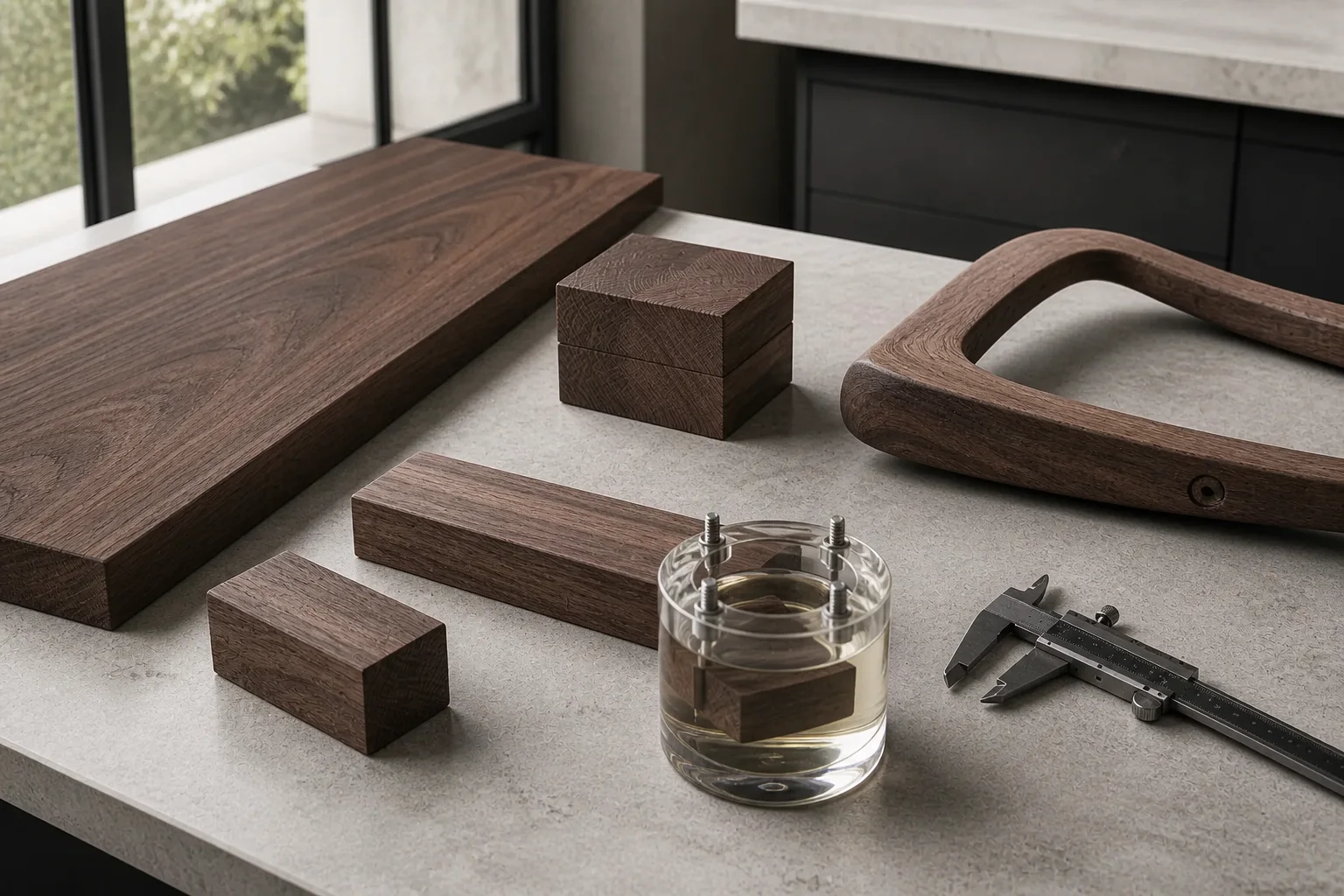
Wood as Structure
Solid wood carries a visible history of growth. Its properties differ along and across the grain, so orientation becomes part of engineering. Sculptural furniture can reveal this structure while using it responsibly.
Natural Variation
No two boards share the same figure, density or pore structure. Stabilization does not erase this variation. It may deepen contrast and create a more resin-saturated, semi-gloss appearance, which is central to the proposed ARQETO material language.
Moisture and Stability
Wood responds to its environment. Dimensional movement depends on species, cut, moisture history and geometry. Stabilization may reduce movement when resin penetrates and cures within the structure, but results depend on the complete process.
Stabilized Wood
In broad terms, stabilization introduces a curable resin into accessible voids in the wood, often using vacuum and a controlled cure. The result can feel denser and show greater optical depth than untreated timber.
ARQETO does not yet publish numerical claims for water absorption, strength, UV resistance or service life. Those values require tests on the actual species, resin formulation and production cycle.
Material Testing
Useful testing may include mass uptake, penetration depth, dimensional response, joint performance, surface wear, heat and UV exposure, cyclic moisture and full-chair load testing. The design and the material process must be validated together.